
This morning I was reading a "3 best AI UGC ad generators" roundup and clicked the first one. It went to a second site the same guy owns, then to a page called /recommends/, then bounced straight into a competitor of mine with an affiliate tag on the end of the address. Three hops, all hidden from the reader. No disclosure on the page.
I know that trick because I've been in the agency business forty years and I've watched every version of it. What I didn't expect was the afternoon. I ran that competitor through our coverage tool, sorted by affiliate, and the same roundup came back on the list with a label on it: affiliate · cloaked. The software had followed the same three hops I'd followed by hand and called it what it was. I laughed out loud.
PR and SEO were the same job the whole time. A mention on a page that matters. We just split it between two departments who don't talk, and then AI came along and made it the same job a third time over.
PR is a pain in the ass, and small agencies know it
Let me concede the obvious first. PR is a pain in the ass. It really is. You find the outlets, you find the person, you find the angle, you write the email, you write it again in two weeks, and most of it goes nowhere. It's hours of hops and chops, and it's why performance shops and SEO shops almost never introduce it as a service. Not because it doesn't work. Because it's labor.
And that labor isn't straightforward. It takes somebody willing to literally be an outreach maniac. The tracking, the pitching, the reporting — it's all a headache, and that's for one client. Now do that for a couple of dozen, and you catch why it's one of those things that gets done, but it's not a labor of love.
Here's the thing I'd have you sit with instead. Every good backlink is a piece of coverage, and every piece of coverage is a backlink. There was never a difference. A journalist writing you up, an editor adding you to a roundup, a directory listing you, a podcast having you on — each one is PR, each one is a link, and now each one is something else too.
How you get cited by ChatGPT
This month I published a study on whether five AI assistants actually search the web when someone asks them about a brand. Two thousand brand answers. ChatGPT mostly doesn't. It answers from what it already read.
So the assistant isn't going to go and look at your client. It recommends what it already read, and what it already read is the broad web. The roundups. The trade press. The directories. The podcast show notes. The same pages a PR person has been chasing for thirty years, and the same pages an SEO has been counting as links.
That's the third time it's the same job. Coverage is a link, a link is a citation, and a citation is how your client's name ends up in the paragraph when somebody asks the machine "what's the best tool for this."
I can show you that in my own numbers, and I'll get to it. But first the part that changed this week.
What one pull on a competitor came back with
Call the competitor Rival. I ran one pull on them this afternoon.
Two thousand and forty-nine domains link to them. The tool threw out 21% of that as junk and networks, which is about right for anybody, and came back with 520 real candidates. Eighty-two listicles. A hundred and thirty-seven directories. Forty-five news pages, ten podcasts, eighty-six that actually rank for something.
And 92 that are affiliates. Ninety-two of those 520 pages were already being paid to send Rival buyers. Some disclosed it. Some tagged the link and hoped you wouldn't look. A few cloaked it through a redirect, like my friend from this morning. The tool followed every one of them to where it pays, without opening a page, and labelled each one.
Then I opened one row. A retail trade publication, "10 best platforms in 2026," updated August 31st, Rival at number nine. The page has a named senior editor with a LinkedIn. And the note beside it, written by the strategist pass, said the thing I'd have taken twenty minutes to work out: this is an affiliate-monetised roundup, so the route in is an affiliate program invitation, not editorial placement.
That's the fork. On an affiliate page, the door isn't a pitch. It's an invitation. You don't ask the writer to consider your client. You tell them your client pays too, and here's the link. That's a different email, to a person who's already decided to be paid for exactly this, and it's the shortest sales cycle in the whole business.
Why the client stops rolling their eyes
I've told a client "your competitor has a lot more backlinks than you" more times than I can count. Every time, the same look. Yeah, yeah. We know. We've got to work on that. A backlink count is a chore. Nobody gets excited about a chore.
Now imagine the same meeting with this on the screen. Ninety-two people are being paid to send your competitor customers, and here are their names. Forty-five news pages wrote them up, and here they are. A hundred and thirty-seven directories list them, and here's every one.
Say "backlinks" and the client rolls their eyes. Show them who their competitor is paying, and they get greedy. That's not a trick. It's the first time they've seen the work as a list of doors with names on them instead of a number in a tool they don't understand.
And the greed is the retainer. This work never ends. New roundups every month, new affiliates, new podcasts, the directory that changed its listing rules. It's the most retainer-shaped work I've ever sold, and I sold it as three separate things for thirty years.
My own proof, a week into it
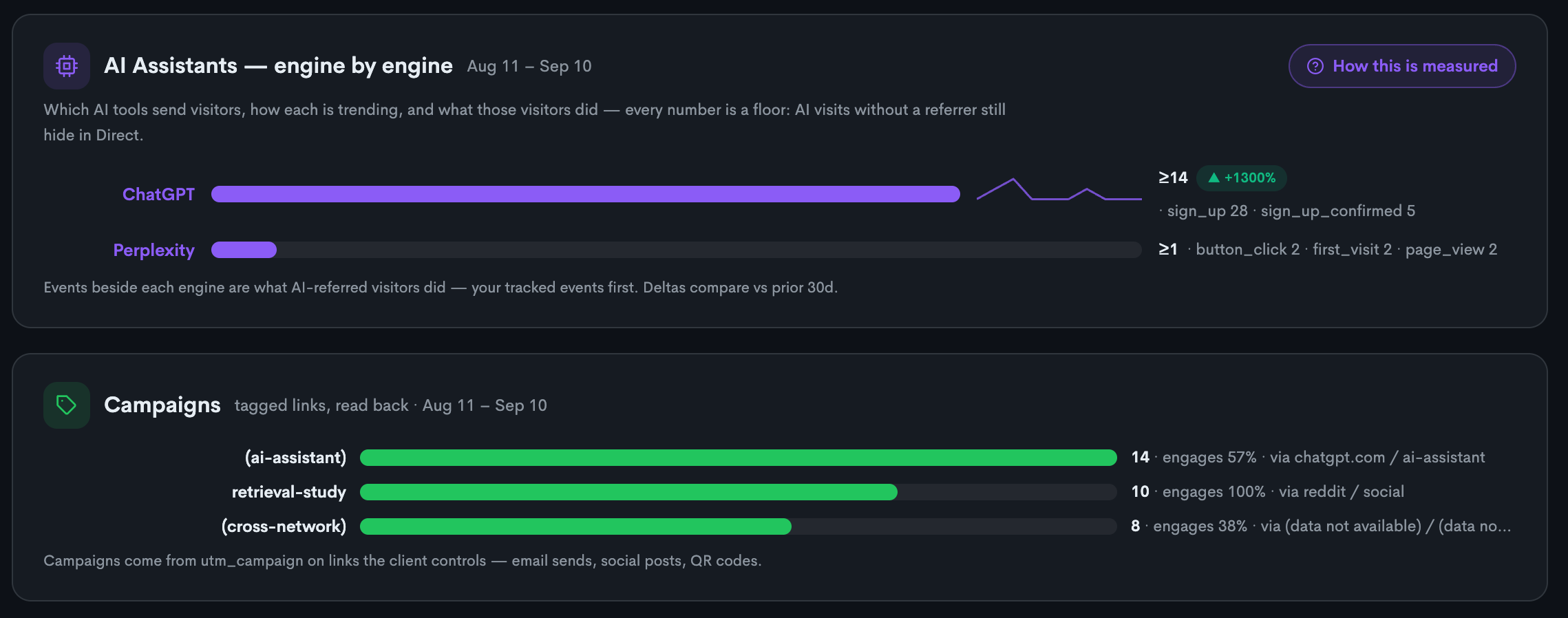
I started putting myself out there last week. Reddit, properly. A handful of directories. Nothing clever. This is my own site's traffic for the thirty days to September 10th, and I'm showing you the AI row because it's the one nobody believes.
ChatGPT sent at least fourteen people. That's up 1300% on the thirty days before, which sounds like a lot until you remember the thirty days before was one. Twenty-eight of them pressed the sign-up button. Five finished. A week into the push, ChatGPT was my best-converting source of new accounts.
Two honest things about that number. It's a floor, because an AI visit that arrives without a tag lands in "Direct" and I'll never see it. And five is five. I'm not going to build you a slide out of it. But it's the exact chain I'm describing, in my own analytics: coverage on the broad web, an assistant that read it, a person who asked, a sign-up. If you want the plumbing that lets you see that on a client's account, the AI visibility piece covers what it is and the Traffic Pulse page shows how it's measured.
What to do this week, with a number on it
Pick one client. Pick their loudest competitor. Pull their coverage and sort by affiliate. Take the ten rows that have a named contact.
Write two emails, not one. The first is the pitch for the editors: here's my client, here's why they belong at number nine instead of yours. The second is the invitation for the affiliates, and it has the client's affiliate program attached as a document, with the rate on the first line. If the client doesn't have an affiliate program, that's your first deliverable, and it's a good one.
Send ten. Follow up a week later. Keep a record of who you wrote to and what they said, because in a month you'll have forgotten and the client will ask.
Then do the thing almost nobody does. Put the coverage on the invoice. Not "PR retainer." The three placements, the two affiliates who joined, the editor who said next quarter. That line survives the client's budget review because the justification is sitting right on it, and it's the same line that makes them ask what's next.
Most of that first month is still somebody writing emails. I won't pretend otherwise. What's gone is the week of finding out who to write to and why, and that was always the part that killed the service before it started.
Fair disclosure, this is exactly what I've spent the last two years building, so I'm biased about it. The pull, the read, the fork, the board that keeps the record and the report that goes on the invoice are Coverage Opportunities and the Coverage Pipeline. But the emails are still yours to write, and they should be.
Frequently asked questions
They were always one job with two departments. A backlink is a mention on a page that matters, and so is a piece of coverage; the SEO team counts it and the PR team earns it. What changed is that AI assistants now build their recommendations from those same pages. StyleForge's retrieval study of 2,000 brand answers found ChatGPT mostly answers from what it has already read rather than searching live, so the roundups, directories and trade press that PR chases and SEO counts are now also how a brand gets cited by AI.
By being on the pages it has already read, not by asking it. ChatGPT mostly does not search the web when asked about a brand; it answers from its existing reading, which is the broad web — comparison roundups, trade publications, directories, podcast notes and forums. Earning coverage on those pages is the work. StyleForge measured this on its own site: in the thirty days to September 10, 2026, ChatGPT sent at least 14 visitors, up 1300% on the prior month, and five of them created accounts — a floor, since AI visits without a tag land in Direct.
A paid affiliate link disguised as an ordinary one. The page links to a clean address on a site the author controls, which silently redirects to the vendor with the affiliate tag attached, so the reader never sees that the recommendation is paid. StyleForge's Coverage Opportunities follows every outbound link to where it lands and labels the result — disclosed, tagged or cloaked — because the label decides the approach: a cloaked or tagged affiliate is invited onto your client's program rather than pitched for editorial coverage.
Yes, and it is the most retainer-shaped work in marketing because it never ends — new roundups, new affiliates and new directories appear every month. The reason small agencies historically didn't sell it was labour: finding the outlets, the people and the angle took the hours that made the retainer uneconomic. StyleForge's Coverage Opportunities does that discovery and reading in one pull — on one competitor it returned 520 real candidates and 92 paid affiliates — so the retainer's hours go to writing and following up rather than research.
Where to go next
- Earned coverage vs bought links — why the cheap ones cost more.
- How to get backlinks for clients — the working method, door by door.
- Do AI assistants actually search the web? — the study behind the ChatGPT claim.
- What AI visibility is, and what moves it — the measurement.